Wednesday, 29 October 2025

Fr. John Garry RIP - A Good and Joyful Man


1994 September Fr. John Garry Nimule Sudan

There is an excellent hour long interview with Fr. John in 2022 at this link...


John passed on suddenly 21 October 2025 in his home in Tullamore Ireland.  This is my small tribute to a man who was kind to everyone and always joyful.

I arrived in Torit Sudan in October 1991. I had visited Palataka mission on several occasions before I moved there from Torit in May 1992.  Fr. Leo Traynor had asked us Maryknoll Lay Missioners to leave Torit because of insecurity from the war.  We arrived in the afternoon of 16th May.  John was living with Fr. Tom McDonnell and neither of them knew we were coming. Leo explained to them what had happened in Torit and they gave us each a big spacious room on the second floor of their house.

1992 Tom Lis Agatha John Abrehet Susan Giovennina

We stayed in Palataka only two weeks trying to assist the 3000 boys in the FACE (Friends of African Children) foundation school with health care. On 28th May Khartoum captured Kapoeta and Fr. Leo brought the Maryknoll Cloister Sisters and S. Doreen, Sacred Heart Sister, to Palataka the next day. Bishop Taban sent a letter with them asking all expatriate personnel to leave the diocese for a while. 

On Sunday morning, 31st May, John was preparing to go to Panyikwara to say Mass.  Commander William Sebit came early with many soldiers and told him they were ordered to take his truck for an important mission.  John handed over the keys and went in another truck to say Mass.

After John left, another man came from Torit. He told Tom that other diocesan vehicles had been confiscated in Torit. The concern was that the SPLA would return to Palataka and take more of our vehicles.  Maryknoll had one vehicle and the Comboni Sisters had another, both hardtop Landcruisers.

John returned midday to chaos and confusion.  He was adamant that all of us expatriate women should take our belongings in our two vehicles and move to Loa Parish, 60 miles away. We left at 4pm. He was concerned that Khartoum might try to come out of Torit towards Palataka and meet us on the way.  He told us if we saw people running towards us to turn around and go back to the mission. 

I wonder what it was like for John and Tom to watch us drive off a few hours before dusk, not knowing what would happen to us. There were no radios or any means of communications at all. We arrived safely in Loa well after dark. Sometime later, John and Tom also left Palataka. But they went south, directly into Uganda. I had left my guitar in Palataka knowing that the Acholi were musically inclined and would surely enjoy using it. John wasn't so generous. He took it to Uganda and returned it to me later; this time with a sticker on the inside that said, Palataka Honey.

John had been happy working in Kenya. When he was assigned to Sudan without consultation he obeyed. But it was challenging.  Around the same time, Sr. Joanne, MMM who had been at his parish in Kipsaramen Kenya had been assigned to Ethiopia and agreed to go.  He told her later that her courage helped him to accept his transfer to the Diocese of Torit. When he arrived, he spent three months learning Latuho.  It is a very difficult language. After three months the bishop asked him to learn Acholi and work in Palataka! Once again he obeyed.  It is an easier language but I give credit to John for keeping at it!!!! He became quite fluent in Acholi! As you will see, Palataka was a 600 acre farm and the place for this farmer's son to settle.

John wanted to do more than grow maize and soya beans. The UN brought in corn/soya blend for the malnourished. He had heard of a program at the U. of Illinois, USA to train farmers on how to extrude soy beans after harvest. So he came to Urbana IL and stayed in our home for a long weekend, along with S. Sean/Nina Underwood, to learn how to extrude the soy beans and process the product to remove the bitter taste.  His idea was to put an extruder on the back of his pick up truck and drive it around to the various fields at harvest time and process the harvest on site. Unfortunately, the research into mobile extruders was still in progress. While he waited for them to progress, the war encroached and dashed his hopeful plan for feeding the hungry.

A lot happened with the war and by Oct 1992 I ended up in Nimule. In November William Nyuon took Palataka while John was in Nairobi for treatment of his back. 

1993 July John Susan Patrick Fleming Lis

John's nephew, Dr. Patrick Fleming, came to work with our medical team in Nimule in July 1993.  He is now an orthopedic surgeon.  But at that time we had many patients with trachoma, an eyelid infection that causes scarring that pulls the eye lashes down and into the eye.  The lashes scratch and scar the cornea causing pain and eventually blindness. Patrick took on this challenge and did surgery on several patients to evert the eyelids and prevent these problems. He came at a time of particular insecurity, especially in Palataka. Patrick left in August and by September it was no longer safe for John to stay in Palataka.

1993 Doreen Taban Rita John

So John relocated to Nimule to live and work in our parish with Leo. It was another difficult transition for him.  The local language was Maadi, one of the most difficult languages in the diocese.  We mainly used Juba Arabic and English to communicate. John struggled to find his place as mayhem continued to unfold with the SPLA.

1993 Nimule church

Christmas 1993 John Marj Lis Susan Nina Pauline

By January 1994 Khartoum had begun its offensive to retake Nimule. On 3rd April, Easter Sunday, 100,000 people in the AAA camps for displaced people up near Loa parish began to move at the command of the SPLA. Between 30-40,000 people walked through Nimule to Sau which was 17 miles south of us.  They were resettled in the Mogali One and Two camps. Amidst all this turmoil we made a special meal on 13th April to celebrate John's 25th ordination to the priesthood. 

John's ministry evolved to include regular visits to the internally displaced peoples' camps (IDP) in Mogali. He told me an endearing story about Magdalena...

In the IDP camps, meager amounts of grain that required grinding by hand between two large stones, pulses, salt and cooking oil were distributed intermittently, never in adequate quantity.  All of my patients were decidedly lean.  Many were severely malnourished.  Magdalena was a small, wiry woman of middle age with jet black skin stretched tautly over her prominent bones and joints.  Her smile displayed bright white teeth that splayed in various directions as she ran up to greet a guest.  She would grab the person’s hand with both of hers and shake them excitedly in a pumping fashion.  There were very few guests to witness her enthusiasm.

     John was one of the fortunate few.  He arrived in Mogali Two one hot sun searing morning on his motor bike to say Mass, having bounced and jostled over a rutted 15-mile path from the mission compound in Nimule. He knew his parishioners and often cringed at their destitution.  For some unknown political reason there had not been any recent distribution of relief food.  People were very hungry.  He carried his few liturgical vessels in a knap sack on his back and set them up on a small table provided under the shade of a bent over, lonely, withering tree.  Magdalena helped to gather the women and children on the dusty ground in a semicircle in front of him.  One or two elderly men were privileged to sit in a rickety, bamboo locally made chair.  But women felt most comfortable sitting on the ground on a reed mat with their legs at right angles to their torso, stretched out in front of them.

     Mass was said in English.  There were more than ten local languages among the faithful and many of them could understand the regular repetitive prayers in this academic language.  Among themselves, they used a simple form of Juba Arabic to communicate.  But no one knew that language well enough to understand the complicated ‘high’ Arabic used in books for prayers.  Magdalena was Nuer, having come from hundreds of miles to the north.  

     Religious liturgies were event markers.  Few patients could tell me the date they were born.  The most frequent answer given to me was a description of the weather or some cataclysmic event in the community.  But everyone knew the date they were baptized as well as the name of the priest who presided, most often a Comboni Missionary priest. Rather than celebrating birthdays, John was often asked to say a Mass for the anniversary of someone’s Baptism.

     But today was just an ordinary Mass.  When this simple, nondescript liturgy ended, John quietly packed up his ruck sack on the back of his motor bike, planning to slip away quickly. Magdalena was distraught.

     “Abuuna, aren’t you going to wait for a small breakfast?” she called out to him using an endearing Arabic title meaning ‘Our Father’.  He turned towards her hesitantly and kept his eyes down a bit.

     “Ah Magdalena, there’s no food at all in the camp and everyone is very hungry.  I’d feel ashamed to be taking your food.”

     “Don’t worry about that,” she smiled with all her teeth shining brilliantly.  “Many of the women each gave me a spoonful of maize meal so I could prepare a bit of porridge for you before you go back to the mission.  Why shouldn’t we give you something to eat when you so generously feed us with the Body of Christ every week?  A small bowl of porridge is nothing compared with this beautiful gift.  It’s our way of saying thank you for coming to see us.  Saying Mass for us is crucial.  Without it, we could never survive in this place.”

     Acknowledging the essence of the liturgy that he thought had been completed, he sat down with them to savor the community porridge over a friendly chat.

The Khartoum government offensive continued. With their troops stationed at Pageri, the SPLA blew up the bridge at the Aswa river 12 miles north of Nimule and the river became the frontline.  From June to August all diocesan personnel in Nimule relocated to northern Uganda. 

In September Bishop Taban asked John and I to investigate working in Pajok, the town on the border of Uganda south of Palataka.  For John this was attractive.  For me it would mean a new adventure. The local SPLA commander was a good man but he cold only guarantee our security in this small village.  Without the ability to serve surrounding communities we returned to assess Nimule. There we found 30,000 people in the Mogali camps with no support for the health care provided by the few local health care workers who lived there.  The need was immense. Bishop Taban approved a small group of us to return to Nimule and travel to Mogali regularly.

By March 1995, Irish GOAL workers had returned as well but could not manage the insecurity where they worked north of us.  Upon leaving they asked John if they could turn over their large stores of medical supplies to the diocese. He agreed but asked them to move the items to the diocesan seminary in Kocoa, northern  Uganda. We would travel to Kocoa on Saturdays to pick up the supplies we needed for the coming week.  One of our trips was surprising....

Early one bright sunny Saturday morning,  John drove me in our big, medical Toyota Landcruiser on a day trip to pick up medical supplies in Kocoa.  It was the rainy season.  Even at this early hour the hot humid air hung heavy as the bonnet of the car batted away freshly grown grasses that clogged the radiator screens with their seed laden heads.  The car wheels matted down the grasses creating two lines of smashed passage by infrequent vehicles that traversed this ‘panya’ route; the route most frequented by rats through the forest. There were only two of us in the front of the car. It was a challenging trip for my priest/driver and boring for me in the passenger’s seat as we lurched along at a snail’s pace.

     I hung my arm over the open window to my right with my head turned in the same direction to keep the sun on the back of my head.  As I watched the ground tediously move from front to back of the car a man’s body rolled into view, lying supine but only from the waist down with tangled entrails exposed.  My eyes locked and the car stopped.

     “Did you see that?” John asked.  I numbly replied yes, turned my head away and looked straight ahead through the windshield.  Only later did I learn that John was referring to the torso of the man that he saw hanging among the branches of a tree on the left side of the car near him.

     We were both completely silent as he began to move the car forward again, inch by inch, slowly following a slight curve to the left.  The forest shadows blocked out the sun as we saw a man standing in the road ahead with one hand raised while the other clutched an AK47 slung across his chest.  He was young, wearing the army uniform of the Ugandan Peoples Defense Force. John brought the car to a dead stop and killed the engine as the short, thin Ugandan soldier began to walk towards us. He stopped on the driver’s side of the car and spoke to us through the open window where John had rested his forearm.

     “You are from Sudan?” the soldier shouted in harsh staccato English.

     “Yes,”  John replied in similar, curt special English. 

     “You see that hole in the ground?” The soldier pointed the weapon in his hands to a substantial cavity in the ground ahead of the car.  We stared through the windshield to the disturbed pile of dirt in front of the vehicle, every muscle of our bodies frozen in place.

     “That was a landmine that blew up.  It killed those who were trying to lay it last night.  What’s more, it was set for you people,” the soldier barked.

     I leaned forward and asked incredulously, “But why would anyone want to kill us?” 

     We knew the soldier was referring to the Lord’s Resistance Army, commonly known as the LRA.  They operated on both sides of the border as a rag tag ‘army’ of Ugandans from the Acholi ethnic group.  John knew their language well, having worked with them for many years in Sudan. This rebel group was born from the visions of a woman known as Alice Lakwena.  She claimed God told her to rebel against the government of Uganda and form a new government based on the ten commandments.

     In her old age, Alice sought refuge in Kenya and a former Catholic catechist, Joseph Kony, took up her mantel back in Uganda, continuing her crusade.  Since the Acholi lived on both sides of the border, they could easily cross into southern Sudan through the bush and set up camps in remote forests.  Having supplied the LRA with means to communicate their location, Sudanese aircraft could then drop all manner of supplies to their remote locations.

     “You are the missionaries,” the soldier replied to my query.  “You are giving the people hope.  In a war when there is an enemy to be defeated, the enemy cannot be given hope.  If you are ever leaving Sudan, do not tell anyone you are going to get your medicines or anything like that.  And do not go in the same way or at a regular time.”

From then on we followed the soldier's advice! In June 1995 John left Nimule to attend the Faith and Mission course at Dalgan Park in Navan Ireland. He returned to Kiryandongo Uganda with Tom McDonnell to work for six years with Sudanese refugees there, most of whom were Acholi.  I visited in January 2002 and it was evident that he was very happy there. He avoided getting in the picture with the women health care workers but his house is in the background. John was always putting us women front and center.

2002 Jan Kiryandongo health workers
John's house is in the back

We kept in touch over the years.  I eventually moved to Kitale Kenya when he was the assistant regional in Nairobi for the St. Patrick Society.  When our hospital was inundated with hundreds of patients during the postelection violence in 2008-2009 he sent funds donated from Ireland to cover the medical needs of the many displaced people from Mt. Elgon who had rarely had access to health care. When he moved to Surrey England to do fund raising for the SPS he offered me a room to stay overnight on my long haul flight back to the USA.

What a shock  to hear of his sudden passing on 21 October 2025. For a man who had faced death so many times earlier in life, it seems unfair that we didn't have a chance to say goodbye. But John knew better than most of us how important the present moment is and he attended to it with enthusiasm and his joy filled smile. While I will miss him, I am sure he continues to cheer all of us along in our life journeys. May he rest in peace. For us, may his memory be a blessing.

2020 Fr. John Garry Ordination Jubilee


Wednesday, 24 September 2025

23 September 2025 Wealth and Poverty

 Twenty-sixth Sunday in Ordinary Time

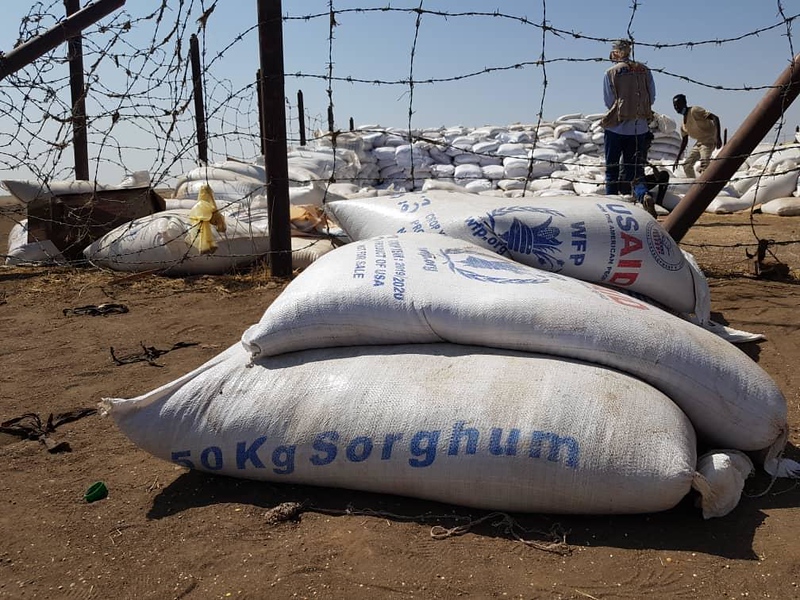
Bags of sorghum from USAID given to people in Sudan on March 4, 2021. Photo by a USAID employee and available in the public domain.

Twenty-sixth Sunday in Ordinary Time

Maryknoll Fr. Frank Breen

September 28, 2025

Amos 6:1a, 4-7, 1 Timothy 6:11-1, Luke 16:19-31

Maryknoll Fr. Frank Breen reflects on the parable of the rich man and Lazarus.

Today’s gospel from Luke, about the rich man and Lazarus the poor man, is one of many passages that highlight a major thematic issue in Luke, namely the relationship between wealth and poverty. The gospels in general do not give a structural analysis of wealth being the cause of poverty, with a few exceptions, and wealth itself is not outright condemned, as some people in the gospels and in Acts are portrayed as wealthy. Luke’s gospel primarily expounds on the moral obligation of those with wealth to assist the poor.

In the first reading from Amos, the prophet denounces the mindless luxury of the rich and their practice of ignoring the plight of the poor. The Psalm (146) lists the same actions as in Isaiah 61:1-2 and Luke 4:18-19, of the ways in which compassion needs to be carried out, for the oppressed, the hungry, the blind, captives, strangers, i.e. immigrants, and the widow and orphan. The Psalm adds an extra admonition: ‘God thwarts the way of the wicked,’ referring to those with wealth who ignore the poor.

In today’s gospel the rich man’s fault is to ignore the poor man at his gate, despite having the luxury to dine very well every day. Another illustrative contrast is presented: although the rich man ignores the plight of Lazarus the dogs come and lick his wounds. In the first century dog saliva was considered to be medicinal. The dogs are presented as being far more humane than the wealthy humans in this parable.

This parable clearly illustrates the radical role reversals already referenced in Luke’s gospel, namely the Magnificat of Mary that the lowly will be lifted up and the rich sent away empty, and the Beatitudes that state “Blessed are the poor and woe to you who are rich.” The rich man’s wealth is no indicator of divine favor. And Lazarus receives honor from God after death, honor he was denied during this lifetime.

Today unfortunately it is not hard to find these same contradictions. Wide and growing disparities in access to the resources needed to sustain life continue to plague the international community. Oxfam reported in 2016 that one percent of the world’s population control half the wealth, and the gap may be even starker today. Just in America alone, close to 12% of the population live in poverty, around 37 to 40 million, whereas ten thousand people are called centi-millionaires, those with a net wealth of over one hundred million dollars, and in 2023 there were 879 billionaires in the United States.

Although not all millionaires and billionaires ignore the plight of the poor, many use their wealth and influence to block programs that will improve the lives of those in poverty, while at the same time promoting policies that enhance their own wealth, such as in low tax rates for the top ten percent. The budget for Medicaid has been reduced by $700 billion over ten years, which will deny millions of people assistance for essential medical care and medications, such as insulin, and it will also inexorably lead to closure of rural hospitals due to lack of funds. Ideological falsehoods are proclaimed that Medicaid is wasteful spending of tax dollars, whereas any accurate evaluation of Medicaid discovers almost no waste.

Globally, the massive cuts to the U.S. Agency for International Development (USAID) have resulted in the termination of financial assistance to numerous countries for health, education, agricultural and infrastructural development, food relief, water projects and, most crucially, for the program that shares antiretroviral therapies that have kept millions of HIV positive people alive, especially in Africa.

To adequately respond to today’s gospel in the modern world is to recognize that not only philanthropy is needed but systemic change that will address the structural causes of poverty. The biblical commentator John T Carroll states: “Jesus’ vision of the reign of God bears little resemblance to the consumer capitalism and preoccupation with wealth acquisition so dominant in modern life.” Seeing Lazarus today requires us to engage in the radical role reversal commanded by Jesus.

Wednesday, 30 July 2025

29 July 2025 - The war on women: A Pax Christi International statement on the situation in Sudan


The war on women: A Pax Christi International statement on the situation in Sudan

Dr. Mawa Mohamed presented the following in a webinar sponsored by PAX Christi International on 29 July 2025.

The webinar of 1 hour:26 minutes can be watched in its entirety on YouTube at this link...https://www.youtube.com/watch?v=wwq8XrA2voQ

A brief summary from my notes follows....

The Sudanese are extremely generous and will share their last plate of food with you.

The youth spearheaded a nonviolent protest in 2019 that resulted in the removal of an autocratic president and the institution of a military government that had agreed to turn over to a civilian led government in three years.  That never happened and the current war began in 2023 on April 15.

Current weapons of this war include the abuse of women.

  1. Women have been raped in front of their families and after witnessing this some men have committed suicide.
  2. Raping women is a means to destroy all of society. A 17 year old woman who had lost both her parents in Khartoum was found living alone and gang raped for four days by soldiers.  She became pregnant and wanted to join a group fleeing to another place.  When they found out she was pregnant they left her behind.
  3. Medical clinics refuse to treat women who have been raped.
  4. 130 young women chose to commit group suicide to avoid being raped which would bring dishonor to their families.
  5. One woman described her life as a living nightmare.
  6. Men have been humiliated along with women by stripping them naked and then killing them.
  7. People have been tortured by locking them in container like boxes until they die
  8. Weapons of war include starvation, torture, looting and destruction of schools, clinics, universities and other civic institutions.
  9. 12 million people have been displaced
  10. At least 180,000 to 200,000 people have died
  11. 30 million people need food aid and 50% of these are children.
  12. There is little publicity because all those people working for human rights have been targeted and killed.

The War on Women: A Statement on the situation in Sudan - Please read the statement at the link below and consider the 8 calls to action, including endorsing the statement.

https://paxchristiusa.org/2025/07/19/the-war-on-women-a-pax-christi-international-statement-on-the-situation-in-sudan/

Pax Christi International invites you or your organization, religious congregation or entity to endorse the statement by filling in this form.


Thursday, 6 February 2025

06 February 2025 Marj returns to Kitale Kenya!

 Message from Marj on 05 February 2025

Marj in Diocese of Kitale

I have arrived in Nairobi and have much to do before I depart for the airport to go to Entebbe this afternoon.

But I want to catch you up a little…more after I reach Kampala as I will have a few days there before driving up to Gulu.


The time in Kitale was really good!  I have, so far, been impressed with the diocesan personnel I have met, including Bishop Henry Juma Odonya, the Diocesan Health Coordinator, Fr. Abraham and his assistant, Carolyn Nalyanya. Fr. Abraham has a masters degree in hospital administration and seems very sincere with his heart in the right place but also very good skills! They have a vision for the diocese, especially with outreach to the poorest and most underserved in West Pokot.


The diocese is expanding but it seems organized.  Time will tell, but  Fr. Abraham and Carolyn, a lay woman, have been most welcoming.  I knew Carolyn from my time at KAP when she worked with a Frenchman named Dominic with Handicap International.  They would often bring medicines to KAP.  She remembered me, so that was a good start.


Our old KAP (Kitale AIDS Program) site is now an outstation of Kiminini Hopsital, with full staff including consulting medical officers (general and specialists).  There are a few beds for “observation” until it is determined if they can be treated there or need to be referred to another facility.


People are extremely worried about USAID issues. The effects have been immediate and already many, many health workers have been laid off, and the future of ARVs, of course, very uncertain.  A few Kenyans I spoke with don’t think it is necessarily bad that they will be forced to find their own way to being more self-sustaining. It is just that there was NO notice and no chance to transition into new ways of surviving and giving good medical care.


The result, of course, right now is chaos.  And total disregard for the very poor who are so desperate.


I will be vising more health sites when I return to Kitale in June.

I am well and happy, Susan.  And promise to write more later.


KAP renovated into an outstation of Kiminini Hospital

Marj giving history of KAP at the opening of the new hospital


Joanne and I now have plenty of money for the 'Restorative Justice' training course aspect of the ministry. But of course, I welcome more donations now for other work in Uganda and in Kenya. 

08 February 2025  Feast of St. Bakhita
Additional note from Susan....Marj and Joanne have both arrived in Uganda and are preparing to travel north to Gulu on 11 February 2025.


Wednesday, 6 March 2024

Immigration


Coralis Salvador MKLM
El Paso Texas


 Super Tuesday - 5th March 2024

     I worked as a Maryknoll Lay Missioner with Coralis Salvador in Mombasa Kenya from 2010-2018.  We have both moved on.  Now I am retired in Urbana Illinois. She continues to work as a Maryknoll Lay Missioner with migrants in El Paso Texas.

     Today is the day that 16 states will vote for their presidential nominees and immigration is one of the most important issues to everyone in this country.

     A recent newsletter from Coralis updated us on her current ministry challenges...

Migrants leave their country as an act of defiance, an act of nonviolence. The shelters of El Paso provide them a respite and service to help them reach their final home in our country.

We are concerned for them because come March 5, Texas Senate Bill 4 (SB4) will take effectSB4 creates state-level crimes for illegally entering or reentering the country and inaugurates a state deportation scheme. The federal government is the body that enforces criminal entry and reentry statutes and the sole arbiter of deportation decisions.

As I write this, the controversy is in court and awaiting final judgement before March 5. In the meantime, Texas law enforcement authorities are given the power to stop, arrest and jail migrants with no documentations. A person accompanying a non-documented migrant could be charged with “smuggling.” As for me, I will continue to serve the migrants without asking them their status.

The majority of El Pasoans view this legislation as discriminatory and racially motivated, targeting individuals with legislation that the state does not have an authority to regulate. To show our protest, our Maryknoll community joined a demonstration and march organized in February as part of a campaign to educate the public on human rights infringements and to oppose the bill.

We urged the state of Texas to eliminate the legislation before it goes into effect. We emphasized our concerns about the potential consequences of the law and called for its repeal to uphold the rights of all individuals, regardless of their immigration status.

     The 5th of March has arrived and after rulings from various courts the US Supreme Court has placed a temporary pause on the controversial Texas border enforcement bill until 13th March, 2024.  For more information on current US government policy at the US border see the offical Maryknoll statement at the following site...

https://maryknollogc.org/resources/statements/maryknoll-ogc-joins-150-faith-groups-letter-president-biden-regarding-anti

     Immigration is an important policy issue to all political parties this election year.  Because I know Coralis well and respect her integrity and Christian committment it is incredulous to me that she could be charged with smuggling for assisting a non-documented migrant.  Please join us by educating yourself about immigration policy and advocating for policies that are consistent with international asylum law.  Then, participate in our democratic process by voting for persons who will respect human rights and enact just laws regarding immigration in our country.

Heidi, Coralis, S Deirdre


     As always, we continue to pray and work for peace with the creative nonviolence of the teachings of Jesus.


11 March 2024 Update

https://elpasomatters.org/2024/03/11/el-paso-annunciation-house-ken-paxton-court-ruling/


     Attorney General Ken Paxton “acted without regard to due process and fair play” in seeking to shut down a leading migrant service provider, an El Paso judge said Monday in a ruling that blocks the state’s efforts for now. 

     “The Attorney General’s efforts to run roughshod over Annunciation House, without regard to due process or fair play, call into question the true motivation for the Attorney General’s attempt to prevent Annunciation House from providing the humanitarian and social services that it provides. There is a real and credible concern that the attempt to prevent Annunciation House from conducting business in Texas was predetermined,” 205th District Judge Francisco Dominguez said in his ruling. 

19 March 2024 - The Texas Supreme Court has extended the ban on #SB4. This extension does NOT include a new date for it to take effect. SB4 was scheduled to take effect on Monday 18 March 2024 at 3pm MT.


Thursday, 2 November 2023

Bishop Paride Taban 01 November 2023


           Today, the Feast of All Saints, Bishop Paride Taban passed on to be with God after being hospitalized in Nairobi Kenya for an infection.  I had the privilege to work in his Diocese of Torit, Sudan from 1991 to 2003.  

     There will be many stories and much written about this compassionate, remarkable man.  I would like to share a short story of my own.  May he now rejoice in the glory of God with everlasting peace.

A Good Shepherd

     “I want you to examine a prisoner of war,” he told me in the dead of night. 

     I was traveling with our Bishop Taban Paride Kenyi Abraham.  Italian missionaries nurtured the Christian faith of his mother and the priest who baptized him gave him the name Paride.  His father was a Muslim and their clan was a mixture of Bari and Kuku peoples.  The names Abraham and Kenyi came from his religion and clan.  During the mother's pregnancy, the father was arrested by local Sudanese police and thrown into jail for many months.  When released from jail, he found his wife pregnant, assumed she had been with another man and, in a rage, beat her ‘properly’.  Soon afterwards, Taban was born.  He looked exactly like his father, confirming the mother’s faithfulness.  The name, Taban, is an Arabic word meaning ‘tired’.  It recalled the misery of domestic violence that mother and child endured during pregnancy.  It was the name we all called him.   This Bishop was a living amalgam of different faiths and cultures.  His entire life was filled with violence.

      Our journey inched over a rutted path that connected the Diocese of Torit in Sudan to northern Kenya.  The SPLA ran a prisoner of war camp in the bush near the border.  We arrived at 11pm. I kept my head down and followed the torch of my Good Shepherd past vague tall, slender figures.  The poorly clad rebel soldiers were visible only when they moved and caused a wrinkle in the profound darkness that illuminated a cornucopia of twinkling stars overhead.

     We stopped before an elderly, wizened soldier sitting on a thin piece of plastic with legs straight out in front of him.  His name was Jamuus.  It means buffalo in Arabic.  Other than a thin blanket, he was naked.  At that moment, we were all enjoying a cool breeze that swept away the ferocious daytime heat.  The air would soon turn bitter cold without clouds above to trap the warmth emanating from soil and stones.  

     The two men both grew up in this diocese learning different mother tongues.  But Jamuus was educated in Arabic and fought for the north. Therefore, the Bishop spoke to him in Arabic.  They were good friends.  My patient was well known for his bravery and skill as an officer in the army of the Sudanese government. The SPLA had captured a valuable prize and reduced him to nothingness.  He allowed me to examine him with my penlight and stethoscope as I knelt at his side on the flimsy tarp, painful stones digging into my kneecaps.  Taban asked about food and he stretched out his hand to retrieve a small tin can from the corner of his plastic sheet, half filled with dry, caked sorghum.  My stomach wretched and I swallowed hard to control it.  A human body that consumed such ‘food’ would surely be harmed but it was all he had.

     It was obvious my exam would be his best treatment.  He needed to know that the gentility of my hand was meant to convey kindness and concern.  I gave him some vitamins and medicine to remove worms.  The Bishop gave him a new, thick blanket.  Neither of us expected him to own any of these gifts for very long.  His guards would help themselves immediately after our departure.  But the Bishop, himself, had been a prisoner of war for one hundred days in an SPLA camp and he knew what this visit would mean to his friend.  Everything.

     I first met this Bishop in Nairobi, Kenya at AMECEA, the Association for Member Episcopal Conferences in Eastern Africa.  Apparently once, when he arrived at the gate of this formidable modern compound, the guard angrily rebuked him for trying to enter at nighttime, shouting that they didn’t admit any refugees.  Taban sported a full and sometimes scruffy beard.  He often traveled in clothes suitable for a journey that might be challenged by mud, rocks and the bush in general.  He could easily resemble, as well as smell like, the sheep of his flock.  

     He had requested missionary priests, Sisters and Brothers to help serve the people of his Diocese in Torit, Sudan.  Long ago, the British had geographically carved up the map of southern Sudan, assigning specific areas to various Christian faith traditions.  Owing to the considerable acrimony and blatant violence among different ethnic groups, the Brits didn’t want the missionaries increasing the background noise by competing for converts.

     It was only later that I would learn about Catholic missionaries first assigned to a different state called Bahr el Ghazal.  These Catholic Europeans utilized this same missionary model and had few if any converts.  At some point, the restriction on different faith groups was relaxed and Protestant missionaries were admitted to that area too.  To the chagrin of the priests, the Protestants succeeded in winning over local people to join them.  Distraught and bewildered, the clergy questioned these converts about their choice to join the Protestants despite long years of hard work by the Catholics.  Their response was straight forward.  They thought that Catholics didn’t allow their members to marry and have families, as evidenced by the celibate missionaries.  The Protestants did.  Since the Sudanese wanted the same, they were more than willing to join up. 

     Of course, Taban knew this history.  His diocese in Eastern Equatoria was also ‘Catholic’ and the missionaries were, for the most part, priests, Sisters and Brothers. So, it was de rigueur for a Catholic bishop to omit lay people in his request. It was lunchtime and I sat at his left.  I knew I was being informally interviewed in the presence of about ten other people.  He was a very busy man.  I wouldn’t get another chance to talk to him.  I asked him if he would take a lay person. His diocese had been decimated by constant war.  The needs were huge and I looked respectable enough.  He looked me up and down and said, rather curtly, “Yes”.  His love for his sheep was not constrained by the routine of the past.  I wasn’t sure what he thought of me.  Time would tell.

     I worked in his diocese for twelve years in health care.  Sometimes we traveled together.  On another safari, both of us were part of a convoy of Diocesan personnel that included several priests and another female lay missioner, once again heading to northern Kenya in the dead of night.  It was cooler to travel after sunset and local bandits couldn’t see what was coming in the dark.  While the would-be robbers slept, we crawled along over an international road that was never worthy of the image that title conjured up in my mind.  This particular journey landed us in Lokichokio, Kenya at 2am.  Taban went to a local business man to find a place to sleep.  Only one room with two beds was available.  The Bishop ordered the two of us women to take the room.  He and the five Irish missionary priests in tow would stretch out on wooden benches encircling the cement slab outside our room.  We women gratefully followed his orders.  It would be only one of many instances where this shepherd made sure every one of his sheep was safe.

     Taban travelled often, advocating for southern Sudan in other parts of the world.  The times when he was present in the Diocese were rare opportunities for me to listen to his lyrical stories and learn from him.  When he was a parish priest in a rural village among his own ethnic group, a man was brought to him who had been gored by a bull.  The unfortunate herder lay on a locally constructed bed carried by his neighbors.  Taban was the most trusted and well-educated person in a place where trained medical personnel didn’t exist. 

      The man lay supine with his abdomen split open.  His intestines glimmered in the rays of sunlight that Taban used to assess the predicament.  Calmly, he drew on common sense and got busy.  Using clean water from a borehole, he gently washed away the dirt and grass that clung to every crevice and corner of the exposed insides. When that laborious task was finished, he gently put the man’s bowels back in his abdomen.  Next, he threaded a sewing needle with white cotton thread and gently approximated the skin edges.  They came together by pulling the stitches and tying them carefully but not too tightly.  If there was bleeding, he dabbed and pressed the spot until the bleeding stopped.  When everything looked dry, he put a clean cloth over the wound and wrote a letter explaining what he had done.  With paper in hand, the villagers carried the man north to the capital city of Juba in search of qualified medical specialists in the government hospital.  The unfortunate man was admitted and observed carefully.  Without any sign of infection or intestinal blockage, he healed quickly and was sent home.  There was no need for anything further to be done.  I was dumfounded.  Had that man been brought to me, my mind would have registered every possible complication in light of the lack of medical equipment I assumed was essential.  I would have been overwhelmed with fear.  Taban taught me to keep my head on straight and do my best.  Paralysis would only ascertain death.      

     While still in the same parish, Taban heard a story about a woman nearby who was injured inside her mud and wattle tukul.  At nighttime, the door had been left open to let in some breeze.  A lion happened by and a paw passed through the opening, slapping down on the head of the sleeping woman.  It tore off her ear and scuttled away.  The woman called for help and was taken to the hospital in Juba by her neighbors.  Ever the vigilant shepherd, Taban set off straight away to visit his parishioner in the capital city who had managed to survive such an attack.  Upon arrival, he was shocked to find the person was his own mother, Sara Mude.  I met her after he narrated this story, a tiny, wiry, very active woman who was a force in her village almost up until her passing in her eighth decade.

     His concern focused on me at one point.  I was working pretty hard on the border between Sudan and Uganda and came down with malaria at a moment when he was passing through our parish. Hearing the traditional clapping of a person requesting entry, I called out to welcome him in to my simple tukul. He found me looking wan and drawn, sitting on the edge of my bed.  Long ago, when I had little immunity, malaria would seize my slight frame and make me wish the end was near. However, after many years and frequent gifts of parasites from mosquitos feasting on my blood, this illness had now simply become a periodic ritual that made me slow down and sleep longer for a couple of days.  He plopped down on the bed next to me, put his arm around my shoulder and suggested, “I can call in a plane to take you to Nairobi”.  Fear wrinkled his jowls as his hand patted my cheek.  “It’s only malaria!” I exclaimed, truly shocked that he would consider such an expensive gesture.  The next day he found me gaining strength as my appetite returned.  Reassured, he took off again in his beleaguered white Toyota landcruiser to another parish while the memory of his concern left me heartened and feeling appreciated. 

Liz Mach, Taban, Susan
    

     He also had a sense of humor.  One day he passed through Nimule on the border with Uganda.  We had reached the southern most tip of Sudan and were hanging on for dear life to avoid becoming refugees by crossing that border.  He showed up wearing a pair of red stockings, very different from his usual well worn sandals.  We chided him for his regal attire and hinted that we would like the same.  A few months later he passed by again with a pair for each of us!


     Most Sudanese who survive to their fifth birthday are fit.  Taban was one of the fittest.  He never drank alcohol and chose a vegetarian diet, avoiding animal products when possible.  He didn’t want people killing their only goat or chicken for him.  He also claimed he never knew if the animal had been raided and he didn’t want to be eating stolen meat.  On another visit to our parish, I caught a glimpse of him in the early morning hours making a round of calisthenics outside his tukul as the grayness subsided and the cacophony of feathered friends crescendoed.  But he worked constantly with few resources.  There was a radio in his landcruiser and offices in Sudan, Uganda and Kenya.  One of his messenger boys half complained to me that he was awakened at midnight by the Bishop to go rouse the secretary to get up and come to his office.  A satellite phone connected him to the BBC and other international entities, especially when confirmation of military activities on the ground required reporting.  

     A story I heard repeated on more than one occasion described a journey made in a convoy from the capital, Juba, to Torit, the seat of his Diocese.  The government was still in control of Torit and the SPLA was besieging the town.  People were dying of starvation.  Taban had organized seventy lorries filled with food to make the 84-mile trip, escorted by the government army.  The government commander strategically placed Taban’s vehicle at a certain place to protect others fore and aft.  SPLA rebels viewing the crawling parade from a range of hills in the distance knew exactly where the Bishop was seated.  They had been ordered to take him out.  His mission of mercy to feed the starving was considered an act of treason against the ‘gallant, liberating’ forces of the SPLA.  But the soldier with his finger on the trigger couldn’t pull it.  Thirty-one days after leaving Juba, the food reached Torit.  There were 20 fewer lorries and many wounded travelers but Taban was not among them.  

     This is a man well known internationally.  In 2010 he was nominated for the Nobel Peace Prize by Voice of the Voiceless.  In 2013, the UN Secretary General, Ban Ki Moon, recognized Taban for building the Holy Trinity Peace Village in Kuron, South Sudan by bestowing the Sergio Vieira de Mello Award for promoting peace, security and better living arrangements for people living in conflict zones.  In 2017 this Peace village was again recognized by the Archbishop of Canterbury, Justin Welby, along with Taban’s role in co-founding the ecumenical New Sudan Council of Churches and Chairmanship of peace negotiations between the Government of South Sudan and the COBRA Faction of the South Sudan Democratic Movement/Army which led to a peace agreement in January 2014.  They gave him the Hubert Walter Award for Reconciliation and Interfaith Cooperation.  Again in 2017, he received a peace award from the United Religious Initiatives for Africa.  In 2018 the Roosevelt Foundation bestowed on him the Freedom of Worship Medal for striving to bring peace and freedom to the people of South Sudan.

     Hopefully these awards have inspired others in the world by the way this shepherd has lived his life.  But such awards don’t mean much to those of us who lived with him, ate with him, prayed with him and were loved by him. Over the course of thirty years in East Africa, I worked with five African bishops, one Irish bishop and countless clergy.  Many were good shepherds of their flocks.  A few were extraordinary.  Taban was one of those who made every person feel like a member of the family, a person whom he would protect and love as his own.  In the end, that is the measure of his achievements and, for us, his holiness.

Blessed are the peacemakers; for they shall be called the children of God.

09 November 2023 - BISHOP PARIDE TABAN NAMED 2023 OPUS PRIZE LAUREATE

https://www1.villanova.edu/university/media/press-releases/2023/opus-laureate.html#:~:text=VILLANOVA%2C%20Pa.%20%28November%209%2C%202023%29%20%E2%80%93%20The%20late,Villanova%20University%20in%20a%20ceremony%20on%20Thursday%20afternoon.